

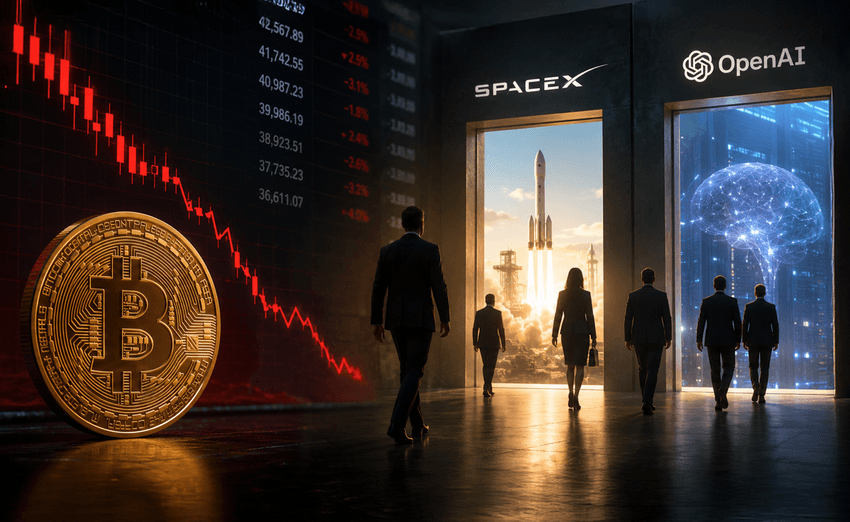

Capital Rotation Emerges as New Theory
Bitcoin’s sharp decline has prompted a new explanation that extends beyond macroeconomic concerns or crypto-specific weakness.
Several market participants now believe the latest correction may be driven by capital rotation, as investors free up liquidity to participate in highly anticipated AI and technology IPOs, including SpaceX, OpenAI, and Anthropic.
The theory gained traction after Bitwise adviser Jeff Park argued that Bitcoin’s liquidity makes it an attractive source of capital whenever major investment opportunities emerge.

The idea suggests that investors are not abandoning Bitcoin altogether but temporarily reallocating capital toward scarce private equity opportunities expected to generate enormous demand.
Bitcoin’s Liquidity Makes It Easy to Sell
Unlike many private investments that can take months to liquidate, Bitcoin trades around the clock and enjoys deep global liquidity.
That makes it one of the easiest assets to sell quickly when investors need immediate cash.
According to supporters of the capital rotation theory, Bitcoin’s accessibility may actually become a disadvantage during periods when investors rush into new opportunities.
Rather than signaling declining confidence in crypto, the selling pressure could simply reflect investors raising funds elsewhere.
SpaceX IPO Captures Investor Attention
At the center of the discussion sits Elon Musk’s SpaceX, which is reportedly preparing one of the largest public offerings in financial history.
The company is expected to seek approximately $75 billion through an IPO that could value the aerospace giant at nearly $1.8 trillion.
The anticipated listing has generated enormous excitement across financial markets, with many investors eager to secure exposure.
At the same time, reports indicate that OpenAI could pursue a future public listing with a valuation approaching $1 trillion, while Anthropic has also emerged as one of the most closely watched AI companies after multiple funding rounds.
The convergence of these high-profile offerings has fueled speculation that institutional and retail investors are repositioning portfolios ahead of potential allocations.
Strategy’s Bitcoin Sale Added Fuel to the Debate
The conversation intensified after Strategy (formerly MicroStrategy) disclosed the sale of 32 Bitcoin, its first BTC sale since 2022.
Although the transaction represented only a tiny fraction of the company’s massive Bitcoin holdings, it challenged the long-standing perception that the firm would never sell its reserves.
The announcement coincided with Bitcoin’s move below key psychological price levels, adding another layer of uncertainty to already fragile market sentiment.
Analysts noted that while the sale itself was relatively insignificant, it may have amplified concerns over liquidity and investor positioning.
Industry Figures Support the Rotation Theory
Several prominent market participants have echoed the capital rotation narrative.
Michael Saylor argued that billions of dollars flowing into artificial intelligence projects represent a temporary shift in liquidity rather than a deterioration in Bitcoin’s long-term fundamentals.
He noted that while AI infrastructure attracted hundreds of billions of dollars in fresh investment, Bitcoin ETFs simultaneously experienced several billion dollars in outflows.
Crypto analyst Ted Pillows similarly warned that AI investment opportunities could continue drawing liquidity away from digital assets.
Meanwhile, FRNT Financial CEO Stephane Ouellette suggested that many retail investors planning to buy SpaceX shares may be selling Bitcoin simply to raise cash ahead of the offering.
Temporary Rotation or Long-Term Trend?
The debate ultimately centers on whether Bitcoin’s weakness reflects a structural shift or merely temporary portfolio rebalancing.
Some analysts believe Bitcoin’s role as one of the world's most liquid digital assets makes it uniquely vulnerable whenever investors chase the next major growth story.
Others argue that once IPO demand subsides, capital could quickly rotate back into crypto markets.
Jeff Park suggested the relationship may become increasingly important in future cycles.
If that prediction proves accurate, future AI booms and blockbuster IPOs may increasingly influence Bitcoin’s short-term price action-not because investors have lost faith in crypto, but because digital assets have become one of the easiest sources of deployable capital.


