

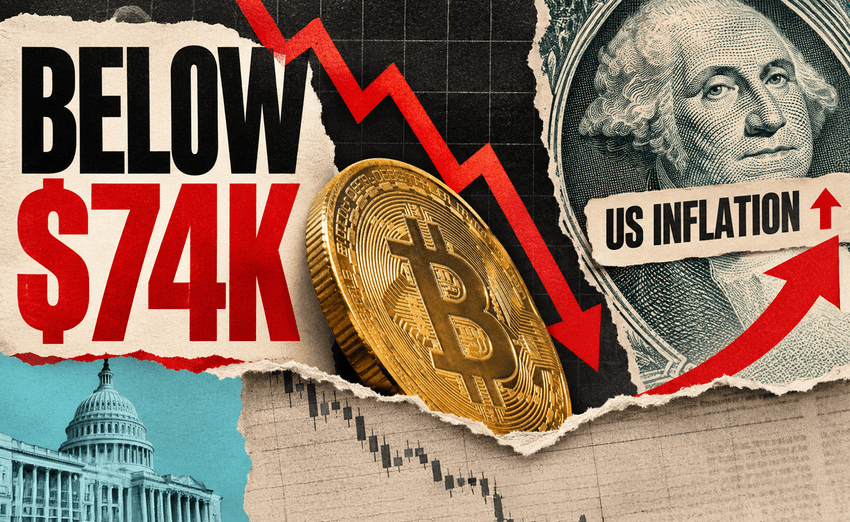

Bitcoin fell below $74,000 on November 10, 2026, after hotter-than-expected US inflation data intensified concerns about the Federal Reserve's interest rate outlook.
The cryptocurrency traded near $73,363, down approximately 1.6%, as investors reacted to the latest Consumer Price Index (CPI) report.
October's headline CPI increased 0.4% month-over-month, exceeding economists' expectations of 0.3%.
Meanwhile, core inflation rose 0.3%, above forecasts of 0.2%, suggesting that underlying price pressures remain persistent.
The disappointing figures raised expectations that the Federal Reserve could maintain tighter monetary conditions, placing additional pressure on cryptocurrencies and other risk-sensitive assets.
Ethereum and Solana Slide as Crypto Market Weakens
The inflation report triggered selling across major cryptocurrencies, with Ethereum and Solana recording larger percentage declines than Bitcoin.
Ethereum dropped approximately 3.7% to $2,042, approaching the psychologically important $2,000 level. Solana performed even worse, falling more than 4% to trade below $83.
Analysts warned that higher Treasury yields and a stronger US dollar could extend cryptocurrency selling pressure.
When borrowing costs rise, investors may become less willing to hold speculative assets, particularly those without predictable income streams.
The market reaction also reflects uncertainty surrounding the Federal Reserve's December interest rate decision.
Bitcoin Faces Critical Support Near $73,000
Analysts have identified the $73,000 region as a crucial technical level that could determine Bitcoin's next major price movement.
Bitget analyst Lewis Huang highlighted Bitcoin's 200-day moving average near $73,200 as an important support indicator.
A sustained decline below that level could increase the risk of further losses.
Matt Mena, senior crypto research strategist at 21Shares, also emphasized $73,000 as a significant historical price region.
According to Mena, a confirmed breakdown could send Bitcoin toward $69,000, bringing the cryptocurrency closer to its previous cycle highs.
Ethereum faces similar technical risks, with analysts identifying $2,000 as immediate support and $1,800 as a potential downside target.
However, these levels represent possible scenarios rather than guaranteed price movements.
Could Bitcoin Recover Toward $85,000?
Despite the recent decline, some analysts believe Bitcoin could recover if buyers defend the $73,000 support area.
21Shares suggested that stabilizing prices and improving stock market sentiment could support a rebound toward $78,000.
A sustained move above that resistance level could potentially open the door to $85,000 before the end of 2026.
Historical seasonality also provides some encouragement for investors.
Since 2010, November has delivered an average Bitcoin return of approximately 34.4%, alongside a median gain of 8.6%.
Nevertheless, historical performance does not guarantee future returns, particularly when inflation and interest rate expectations dominate financial markets.
Federal Reserve Policy Could Determine Bitcoin's Direction
The Federal Reserve's next monetary policy decisions remain a major factor influencing Bitcoin's outlook.
Persistent inflation could strengthen expectations of additional rate increases, potentially limiting demand for riskier investments.
Wincent senior director Paul Howard noted that institutional investors increasingly use derivatives and hedging strategies to manage cryptocurrency exposure.
These instruments may change how Bitcoin responds to economic developments as institutional participation expands.
However, without improving liquidity, regulatory clarity or stronger institutional investment flows, Howard expects Bitcoin could face continued downward pressure rather than a sustained rally toward $100,000.
For now, investors are watching whether Bitcoin can maintain support near $73,000.
A decisive break below that level could increase the risk of a move toward $69,000, while renewed buying pressure could support another attempt to reclaim $78,000.


