

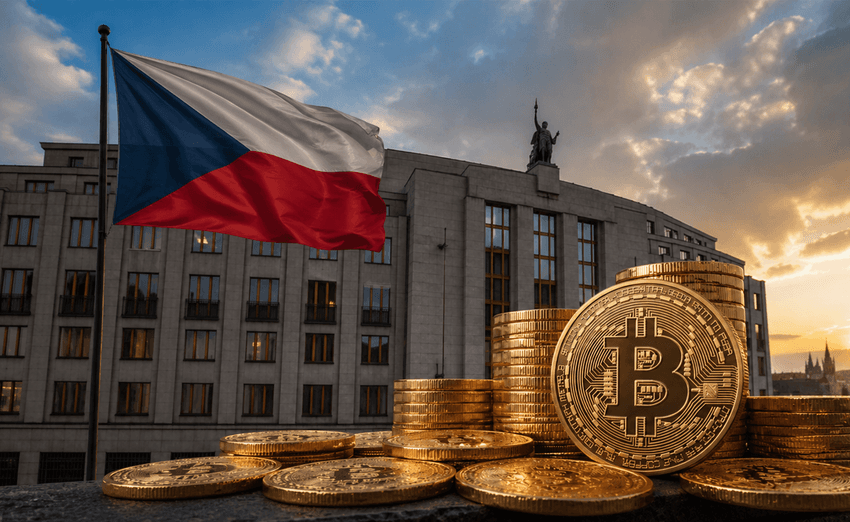

A New Reserve Strategy Emerges
The Czech National Bank is seriously exploring the idea of adding Bitcoin to its national reserves, marking a potential shift in how central banks approach diversification.
Governor Aleš Michl brought the discussion into the spotlight during the Bitcoin 2026 conference in Las Vegas, arguing that traditional reserve strategies may no longer be enough in today’s evolving financial landscape.
He emphasized that central banks must rethink how they structure reserves, especially as digital assets continue to mature and integrate into global markets.
The Data Behind the Bitcoin Case
According to internal research presented by Michl, even a small Bitcoin allocation could make a meaningful difference.
The study found that adding just 1% Bitcoin exposure to the bank’s roughly $180 billion reserve portfolio could improve expected returns without significantly increasing risk. The reasoning lies in Bitcoin’s low correlation with traditional assets like bonds and gold.
This means Bitcoin may behave differently during market cycles, potentially offering diversification benefits that legacy assets cannot provide.
However, the bank made it clear that these conclusions are based on historical performance, not guaranteed future outcomes-an important distinction as volatility remains a core concern.
Challenging the Traditional Playbook
Michl’s stance directly contrasts with the view of Christine Lagarde, who has consistently argued that reserve assets must prioritize stability, liquidity, and security, effectively ruling out Bitcoin.
The Czech perspective, however, introduces a new angle: instead of dismissing Bitcoin outright, the focus is shifting toward whether central banks can afford to ignore its growing role in global portfolios.
Supporters of the idea point to Bitcoin’s lack of counterparty risk and its increasing integration into financial markets as reasons it deserves consideration alongside traditional reserve assets.
From Experiment to Policy Discussion
The Czech National Bank has already experimented with digital assets through a test portfolio, but until now, Bitcoin has remained outside official reserves.
Michl’s latest comments signal a transition from experimental phase to strategic evaluation, placing Bitcoin into the same conversation as gold and equities.
At the same time, the bank is not abandoning traditional assets. It continues to expand its gold holdings, targeting 100 tons, with current reserves already exceeding 67 metric tons.
Risks Still on the Table
Despite the growing interest, the bank remains cautious.
Analysts highlighted that Bitcoin’s financial characteristics are still unstable, with high volatility and changing correlations over time. This makes it difficult to treat the asset as a fully reliable reserve component-at least for now.
Instead of rushing into allocation, the Czech National Bank currently views Bitcoin as a “logical component” for consideration, rather than an immediate addition to reserves.
A Shift in Central Bank Thinking
Michl’s presentation signals something bigger than just one country exploring Bitcoin.
It reflects a broader shift in central banking philosophy, where diversification strategies are expanding beyond traditional instruments.
Bitcoin is no longer being dismissed outright-it’s being studied, measured, and debated at the highest levels of monetary policy.
And that alone marks a major change in how the global financial system is beginning to see crypto.


