

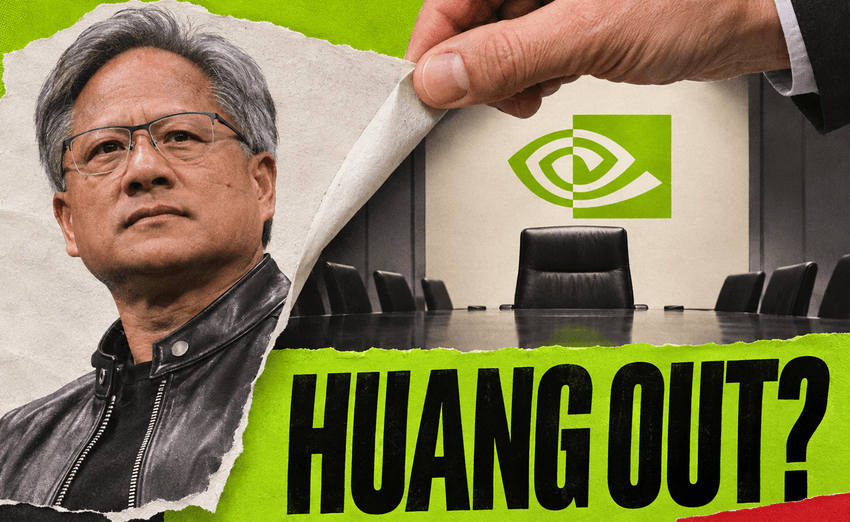

Nvidia's board of directors is reportedly considering removing CEO Jensen Huang following allegations involving two extramarital relationships and concerns about potential Chinese intelligence connections.
According to a November 11, 2026, report from The Wall Street Journal, directors were preparing to meet as early as Wednesday to discuss Huang's future.
The potential departure would mark a dramatic leadership change for Nvidia, which Huang co-founded in 1993 and has led for more than three decades.
However, no final board decision or formal dismissal had been confirmed at the time of reporting.
The controversy comes as Nvidia faces mounting investor concerns about artificial intelligence spending and the sustainability of its rapid growth.
Allegations Involving Suspected Chinese Intelligence
Nvidia's board previously launched an investigation into Huang's relationship with Alice Huang, an executive associated with Singapore-based technology company Megaspeed.
According to The Wall Street Journal, US intelligence officials suspect Alice Huang, who is unrelated to Jensen Huang, of providing information to Chinese intelligence services.
Those allegations remain the subject of reporting and investigation, rather than a publicly established criminal finding.
Jensen Huang acknowledged having an extramarital relationship and apologized to Nvidia employees for violating their trust.
The investigation is examining whether the CEO was targeted by a foreign intelligence operation, raising questions about corporate security and access to sensitive information
The allegations are particularly significant because Nvidia supplies advanced processors used in AI development, an industry subject to extensive US-China technology restrictions.
Second Alleged Relationship Adds Pressure
The New York Times separately reported that Huang had an extramarital relationship with Kimberly Powell, Nvidia's vice president of healthcare.
The report cited five people who previously worked at the company.
Powell oversees Nvidia's healthcare operations, including AI technology used in medical imaging, pharmaceutical research and biological sciences.
According to the report, Huang and Powell were seen behaving affectionately at a San Jose hotel during March.
The allegations raise potential corporate governance questions because Powell reports to Huang.
Nvidia's internal policies address conflicts of interest involving personal relationships between employees.
However, the reported relationship has not resulted in a publicly confirmed finding that either executive violated company rules.
Nvidia Shares Slide as AI Spending Concerns Grow
Nvidia shares fell approximately 8% in after-hours trading following reports of the potential leadership change.
The decline adds to broader pressure on technology stocks as investors question whether companies can generate sufficient returns from enormous AI infrastructure investments.
Nvidia's processors power data centers used to train and operate advanced artificial intelligence systems.
However, concerns about electricity costs, data center construction and future demand have increased market uncertainty.
Recent US midterm election results have also raised questions about potential restrictions on large AI infrastructure projects.
Investors are consequently monitoring both Nvidia's corporate governance challenges and the financial outlook for the wider AI industry.
Potential CEO Departure Raises Succession Questions
Removing Jensen Huang would create significant uncertainty about Nvidia's future leadership, given his central role in the company's development.
Huang has become closely associated with Nvidia's position in the global AI industry, maintaining relationships with major technology customers and government officials.
A leadership transition could therefore introduce additional operational and strategic challenges.
However, Nvidia has not publicly confirmed a successor or announced that Huang is leaving the company.
For now, the board's investigation and reported discussions remain ongoing.
The outcome could influence investor confidence at a time when Nvidia is already navigating heightened scrutiny of AI infrastructure spending, corporate governance and international technology security.


