

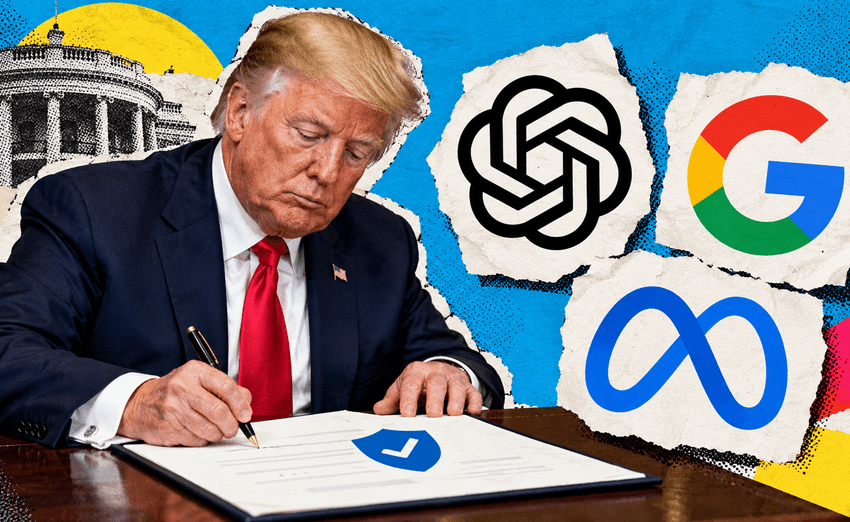

President Donald Trump and executives from some of the world's largest technology companies signed a voluntary AI safety agreement on September 29, establishing shared principles for overseeing increasingly powerful models.
The agreement, known as the “Joint Commitment on Frontier Responsibilities” emerged from a White House luncheon attended by leaders from companies including OpenAI, Google, Meta, Anthropic, xAI and Nvidia. Trump described the agreement as “morally binding,” although it does not carry the force of federal law.
The accord signals the administration's current preference for industry-led safeguards and self-regulation rather than a new mandatory federal licensing system for frontier AI.

Trump said the companies would engage in substantial self-policing, while acknowledging that the agreement relies on voluntary compliance rather than legal enforcement.
Major AI Companies Join the Accord
The White House gathering brought together executives from across the AI industry, including OpenAI President Greg Brockman, Google CEO Sundar Pichai, Meta CEO Mark Zuckerberg, Anthropic CEO Dario Amodei, Nvidia CEO Jensen Huang and Elon Musk.
Nvidia's involvement is particularly notable because the company primarily supplies the computing hardware powering advanced AI systems, rather than operating solely as a frontier model developer.
Its participation reflects the widening scope of AI governance discussions as policymakers consider not only model developers but also the infrastructure companies supporting the industry's rapid expansion.
The accord effectively places participating companies under a common set of voluntary expectations even as they continue competing aggressively for customers, talent and computing capacity.
Four Layers of AI Safety Controls
The agreement establishes four layers of controls and auditing intended to identify potential problems during the development and deployment of advanced AI systems.
Companies commit to implementing internal safety monitoring during model development, followed by a specialized internal oversight function responsible for evaluating whether those controls operate effectively.
A third layer introduces independent external auditors, while a fourth calls for independent board-level oversight that reviews reports concerning the effectiveness of the safety controls.
The agreement particularly highlights risks involving areas such as cybersecurity and biosecurity, where increasingly capable AI models could potentially facilitate harmful activity.
However, the accord does not create a government auditing agency or establish mandatory public disclosure of individual audit findings. Participating companies retain substantial control over how their oversight structures are implemented.
Companies Will Continue Coordinating
The participating companies also agreed to meet regularly to develop standards and best practices, suggesting the framework is intended to evolve rather than remain a one-time pledge.
That coordination could help establish common expectations across an industry where individual companies currently maintain different approaches to model testing, risk classification and deployment safeguards.
The framework follows earlier administration efforts to create voluntary cooperation with frontier AI developers. A June executive order directed federal officials to develop a voluntary system through which companies could engage with the government regarding advanced models and provide controlled early access under specified safeguards.
That order explicitly stated that the framework should not establish mandatory federal licensing or preclearance requirements for releasing new AI models.
AI Becomes “Super Intelligence” in Federal Documents
Alongside the industry agreement, Trump signed an executive order directing federal agencies to adopt “Super Intelligence” and “SI” as the preferred terminology instead of “Artificial Intelligence” and “AI” in official communications and non-statutory documents.
The terminology change does not itself alter how AI companies are regulated, but it reflects the administration's broader effort to frame advanced AI as a transformational technology.
The voluntary accord also leaves open the possibility of stronger requirements later.
Reporting on the final document indicates that participants acknowledged the possibility of eventually codifying parts of the framework into laws or regulations if policymakers determine that approach is appropriate.
For now, however, compliance depends primarily on corporate governance, independent auditing and reputational accountability rather than statutory penalties.
The key test will be whether external auditors and company boards exercise meaningful independence when significant safety concerns emerge. The September agreement establishes a shared framework, but its effectiveness will ultimately depend on how participating companies implement the commitments when commercial pressures and safety concerns collide.


