

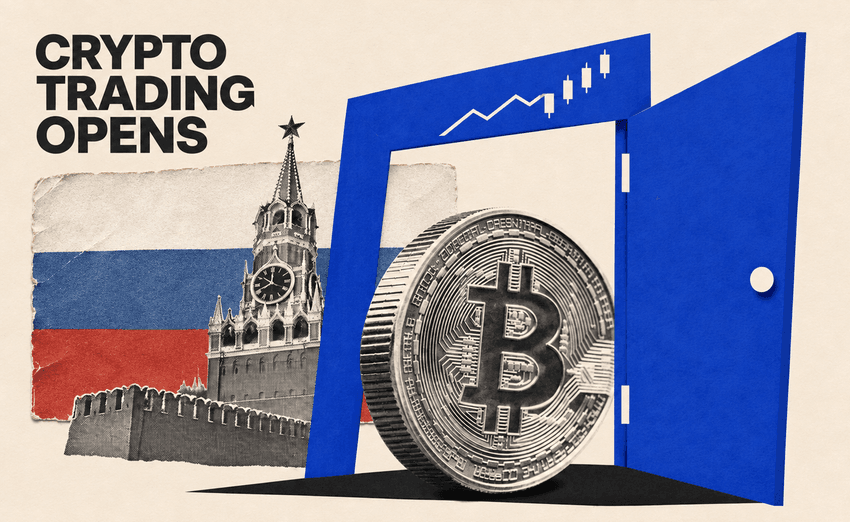

Russia has officially authorized licensed cryptocurrency exchanges to begin trading digital assets, marking a significant regulatory development for the country's cryptocurrency industry.
The new rules took effect on November 22, 2026, allowing approved platforms to offer cryptocurrency trading once their operating procedures receive authorization from the Central Bank of Russia (CBR).
The framework is established under Central Bank Directive No. 7438-U, which introduces requirements for organized cryptocurrency trading.
However, the effective date does not mean every licensed exchange has started operating.
Platforms must first receive approval for their trading rules and complete the necessary technical and regulatory preparations.
Bitcoin, Ethereum and USDT Approved for Retail Investors
Russian retail investors can now legally purchase Bitcoin, Ethereum and Tether's USDT through authorized financial intermediaries.
A separate central bank directive, effective November 17, established these three assets as eligible for non-qualified investors.
However, ordinary investors face an annual purchase limit of 300,000 rubles, approximately $3,700, through each intermediary.
The restrictions are intended to limit exposure to cryptocurrency volatility while allowing regulated market participation.
Investors must also complete mandatory assessments demonstrating their understanding of cryptocurrency risks.
Meanwhile, qualified investors can access a broader range of digital assets under the applicable regulations.
Trading must take place through authorized intermediaries, including licensed exchanges, brokers and asset management companies.
Crypto Exchanges Face Strict Central Bank Oversight
The new framework introduces detailed compliance obligations for cryptocurrency exchanges, bringing digital asset trading closer to Russia's traditional financial market structure.
Authorized platforms must register participating brokers, trust managers and central counterparties.
They must also maintain detailed records of trading orders, completed transactions and market activity.
Exchanges are required to calculate current prices, volume-weighted average prices, market prices and closing prices for listed cryptocurrencies.
This information must be reported to the central bank under requirements comparable to those applied to traditional financial instruments.
The framework follows Russia's broader cryptocurrency legislation, which took effect in September 2026 and introduced licensing requirements for exchanges and digital asset custodians.
Sberbank and Moscow Exchange Prepare December Launch
Major Russian financial institutions are preparing to introduce cryptocurrency trading services, although implementation timelines vary.
Sberbank and the Moscow Exchange have announced plans to begin offering cryptocurrency trading around December 1.
The Moscow Exchange is preparing infrastructure for Bitcoin, Ethereum and USDT transactions.
Meanwhile, the St. Petersburg-based SPB Exchange expects to launch trading before the end of 2026, following ongoing technical testing.
Other institutions, including VTB and T-Bank, have expressed interest in providing cryptocurrency services once the remaining requirements are finalized.
However, some brokers have indicated they may delay their participation until 2027.
Industry representatives expect the regulated cryptocurrency market to develop gradually, rather than launching at full capacity immediately.
Russia's Crypto Market Faces Challenges Despite Legalization
Russia's cryptocurrency legalization efforts follow years of regulatory restrictions and increasing international financial sanctions.
The government is developing domestic trading and custody infrastructure while maintaining strict oversight of participating companies.
Some market analysts believe the regulated cryptocurrency sector could eventually attract substantial investment.
One projection places the potential domestic market at 1 trillion rubles, equivalent to more than $12 billion.
However, blockchain analytics company Chainalysis reported that Russia's cryptocurrency economy contracted approximately 14.7% during the year ending June 2026.
Strict licensing requirements and investor restrictions could also limit participation by smaller businesses.
For now, Russia's new rules establish a legal pathway for cryptocurrency trading, with the first major exchange launches expected in December.
The coming months will show how quickly financial institutions can implement the framework and whether domestic investor demand supports its expansion.


