

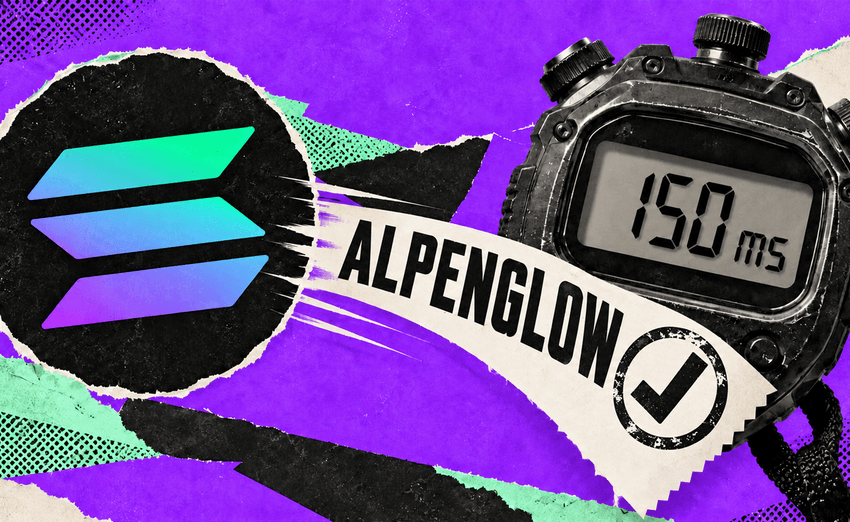

Solana has officially activated its Alpenglow consensus upgrade, introducing one of the most significant changes to the blockchain since its launch in March 2020.
The upgrade went live on October 21, 2026, reducing transaction finality from approximately 12.8 seconds to just 150 milliseconds.
Validators completed the transition at slot 459,653,000, around 14:00 UTC, replacing the TowerBFT consensus mechanism without restarting the blockchain or abandoning its existing ledger.
The transition required independent validators to coordinate the activation while the network continued operating.

The comparison refers to Ethereum's historic transition from proof-of-work to proof-of-stake in September 2022.
Alpenglow is now live on Solana mainnet. ⛰️
— Solana (@solana) October 21, 2026
Finality just went from ~12.8 seconds to ~150ms.
The biggest consensus upgrade in Solana’s history, built by @anza_xyz. https://t.co/rsvNmBYDzi
Alpenglow is now live on Solana mainnet. ⛰️
— Solana (@solana) October 21, 2026
Finality just went from ~12.8 seconds to ~150ms.
The biggest consensus upgrade in Solana’s history, built by @anza_xyz. https://t.co/rsvNmBYDzi
Alpenglow Makes Solana Transactions Nearly Instant
The biggest improvement introduced by Alpenglow concerns transaction finality, the point at which a blockchain transaction becomes irreversible.
Previously, Solana could provide initial transaction confirmations within seconds, but full finality generally required around 12.8 seconds.
With Alpenglow, the confirmation and finality processes are effectively combined, allowing transactions to become final in approximately 150 milliseconds under favorable network conditions.
This improvement could benefit cryptocurrency exchanges, decentralized applications, payment providers and financial institutions that require fast and reliable transaction settlement.
Unlike transaction throughput, finality measures how quickly a completed transaction becomes irreversible.
How Alpenglow's Consensus Mechanism Works
Alpenglow replaces TowerBFT's voting structure with a system allowing validators to communicate votes directly rather than recording them in subsequent blocks.
Validator votes remain weighted according to the amount of SOL staked.
Under one finalization method, a block becomes final when validators representing 80% of the network's stake approve it.
Another method uses two voting rounds, each requiring 60% of stake, potentially improving performance when validators are geographically close.
The protocol is designed to tolerate less than 20% malicious stake alongside another 20% temporarily offline.
If blocks cannot be finalized for 10 seconds, the system gradually increases block times to accommodate slower communication.
The design originated from research published in May 2025 by Anza researchers led by ETH Zurich professor Roger Wattenhofer.
Validators Approved Upgrade With 98% Support
Alpenglow's activation followed an extensive development and testing process.
Solana validators approved the upgrade in September 2025, with approximately 98% supporting proposal SIMD-0236.
Public testing included security assessments, penetration testing, migration rehearsals and a security competition.
The protocol subsequently reached Solana's community test cluster in May 2026 before progressing through additional testing environments.
Anza implemented Alpenglow within its Agave validator software, while independent network operators coordinated the final activation.
The October 21 mainnet launch date was confirmed on October 13.
More Solana Network Upgrades Are Planned
Alpenglow also establishes the foundation for additional improvements to Solana's network performance and infrastructure.
The planned Rotor upgrade would optimize how block data spreads between validators, while geographically aware leader rotation could reduce communication delays.
Researchers are also exploring Quantumglow, a proposed design that would introduce quantum-resistant signatures while preserving fast finality.
None of these developments has a confirmed activation date.
Meanwhile, Jump Crypto's Firedancer developers have proposed removing Solana's current 60 million compute-unit limit per block.
Supporters argue that larger blocks could improve network capacity, while critics warn that higher hardware requirements might favor well-funded validators.
For now, Alpenglow represents a major technical milestone for Solana, bringing near-instant transaction finality to its mainnet while opening the door to further infrastructure improvements.


