

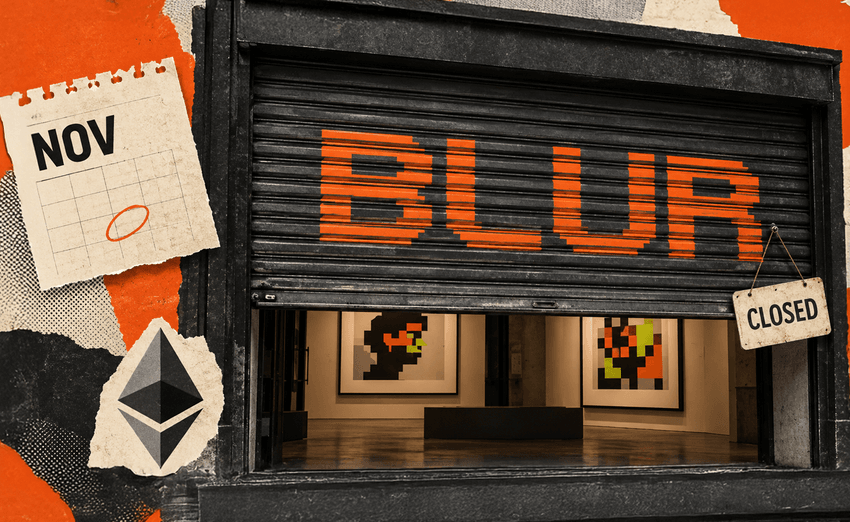

Blur, once the largest NFT marketplace on Ethereum, has announced plans to discontinue its trading interface on November 12, 2026, marking the end of its consumer-facing marketplace.
The company confirmed the decision in an October 12 announcement on X, explaining that its website will no longer support NFT trading after the deadline.
However, Blur's underlying trading protocol will remain operational, allowing users to interact with its smart contracts directly or through third-party aggregators.
The announcement also confirmed that Blend, Blur's NFT-backed lending protocol, will stop facilitating loans on November 12.
Borrowers must repay their outstanding loans before the deadline or allow them to default under the protocol's existing terms.
1/ The https://t.co/zPQ1jqR7pT frontend will be deprecated on November 12, 2026.
— Blur (@blur_io) October 12, 2026
This deprecation only applies to the frontend.
The Blur marketplace protocol will remain operational on-chain, and $BLUR will continue to control its fee switch.
1/ The https://t.co/zPQ1jqR7pT frontend will be deprecated on November 12, 2026.
— Blur (@blur_io) October 12, 2026
This deprecation only applies to the frontend.
The Blur marketplace protocol will remain operational on-chain, and $BLUR will continue to control its fee switch.

Following the shutdown, the company plans to provide a separate interface allowing users to withdraw remaining assets from Blend.
From Ethereum NFT Leader to Market Decline
Blur launched in late 2022, entering the NFT market as trading activity began declining from its earlier speculative highs.
Despite difficult conditions, the platform quickly gained popularity by introducing professional trading tools and incentives designed for active NFT traders.
Its biggest breakthrough came in early 2023, when Blur overtook OpenSea in Ethereum NFT trading volume.
The platform's rapid expansion was largely driven by its BLUR token airdrop, which rewarded users for trading activity and marketplace participation.
The incentive program helped generate billions of dollars in NFT transactions, temporarily establishing Blur as the industry's dominant trading platform.
However, the strategy also attracted criticism from collectors who argued that aggressive trading incentives encouraged speculation rather than long-term NFT ownership.
Some analysts raised concerns about potential wash trading, where transactions artificially inflate reported trading activity.
Blur disputed those interpretations, arguing that its trading model had been misunderstood.
Trading Volume Falls From $1.43 Billion Peak
Blur's market position weakened considerably as NFT demand declined and token incentives lost their appeal.
According to Token Terminal, the platform recorded approximately $19.15 million in trading volume during September 2026.
That represents a dramatic decline from its March 2023 peak of nearly $1.43 billion in monthly transactions.
Over the preceding 12 months, OpenSea reclaimed its position ahead of Blur, generating approximately $557 million in NFT trading volume, compared with Blur's $235 million.
The figures illustrate how significantly marketplace activity has changed since the NFT trading boom.
As NFT prices fell and speculative demand weakened, Blur struggled to maintain the momentum that initially helped it challenge OpenSea.
The decline also affected the platform's native cryptocurrency, which had played an important role in attracting traders.
BLUR Token Crashes 99.8% From All-Time High
Following the shutdown announcement, BLUR dropped approximately 35% within 24 hours, reaching a new low of around $0.0115 on October 13.
At that price, the token had lost approximately 99.8% of its value compared with its all-time high above $5.
The collapse reflects the reduced demand for marketplace incentives and uncertainty surrounding the token's future utility.
Meanwhile, reactions from the NFT community were divided.
Some collectors welcomed the closure, blaming Blur's incentive-driven trading model for contributing to market instability.
Others interpreted the announcement as another indication of how far the NFT sector has declined since its previous peak.
NFT Industry Faces Another Wave of Closures
Blur's shutdown follows several other high-profile closures across the NFT and Ethereum ecosystems.
Earlier in October, Blur founder Tieshun “Pacman” Roquerre announced that Ethereum Layer 2 network Blast would shut down on October 26, following a decline in revenue.
Another Ethereum scaling network, Abstract, is also scheduled to close in December.
Elsewhere, NFT marketplaces Nifty Gateway and Foundation shut down during 2026, while Magic Eden reduced parts of its NFT operations as it shifted business priorities.
Together, these developments highlight the financial pressures facing platforms built around NFT trading and speculative activity.
Although Blur's underlying smart contracts will remain accessible, the closure of its marketplace interface marks the end of a platform that once reshaped Ethereum NFT trading.


