

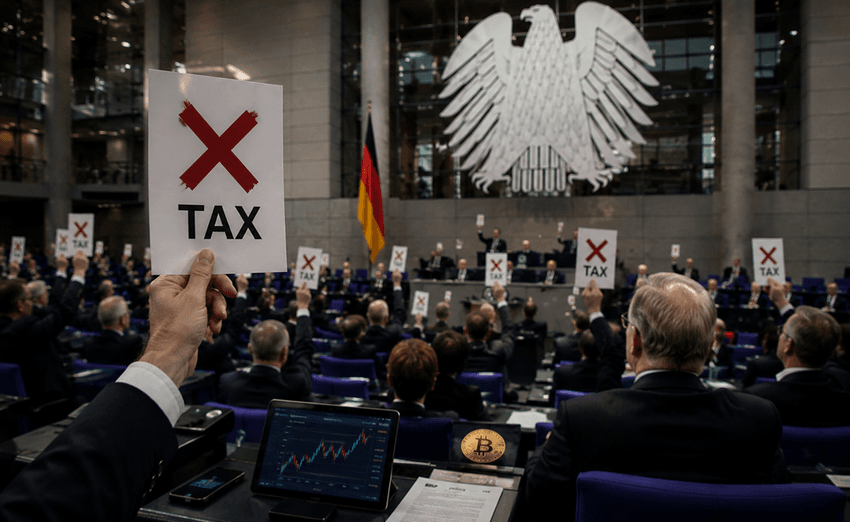

Bundestag Stops Green Party Crypto Tax Proposal
Germany’s lower house of parliament, the Bundestag, has rejected an effort to increase taxes on cryptocurrency investors after lawmakers failed to support a proposal introduced by the Alliance 90/The Greens.
The draft legislation was halted in the Bundestag’s Finance Committee, receiving support only from the Left Party faction, known as Die Linke.
The proposal aimed to remove Germany’s long-standing tax exemption on profits from cryptocurrencies such as Bitcoin and Ethereum when investors hold assets for more than one year before selling.
Under current German tax rules, crypto gains remain tax-free after a 12-month holding period - a policy that continues to stay in place following the committee vote.
Greens Wanted Crypto Treated Like Other Investments
The Greens argued that the existing exemption was outdated and unfair.
According to the party, the original rule was designed for assets such as antiques or collectibles that appreciate over long periods, not for modern digital assets generating billions in speculative profits.
Lawmakers behind the proposal wanted cryptocurrencies to be taxed more similarly to traditional financial investments.
The party also hoped the measure would generate billions in additional state revenue. Estimates cited during the debate suggested Germany could potentially collect at least half of an expected €11.4 billion in additional tax income linked to crypto-related gains.
Critics Warned Proposal Could Hurt Investors
Opponents quickly pushed back against the proposal, arguing it would create unfair treatment for crypto holders.
Members of the ruling CDU/CSU coalition claimed the legislation would not close loopholes but instead create new inconsistencies inside Germany’s tax framework.
Critics argued that under the proposal, crypto investors could end up facing heavier taxation than people investing in traditional assets like precious metals or foreign currencies.
The far-right Alternative for Germany party also opposed the bill, arguing that the government should reduce taxation overall instead of expanding new revenue streams.
Party representatives said Berlin should focus on core government responsibilities such as public security and judicial administration rather than searching for additional taxes targeting digital assets.
SPD Signals Future Tax Changes Could Still Come
Although the proposal failed, Germany’s debate around crypto taxation is far from over.
The Social Democratic Party of Germany (SPD), currently part of the ruling coalition, generally supports stricter crypto taxation policies.
However, SPD lawmakers argued that any reforms should wait until Finance Minister Lars Klingbeil introduces his own broader taxation proposals.
That leaves open the possibility that Germany could revisit crypto taxation reforms in the future, especially as European regulators continue tightening oversight of digital assets.
New EU Reporting Rules Already Taking Effect
Even without the Greens’ proposal advancing, Germany is already moving toward stricter crypto transparency requirements.
One major upcoming change involves implementation of the European Union’s DAC8 directive, which officially entered force in Germany on January 1, 2026.
Under those rules, crypto service providers will be required to collect and report customer transaction data directly to tax authorities.
The reporting framework is designed to improve tax compliance and reduce the ability of crypto users to hide gains from authorities across the EU.
Supporters argue the new reporting standards will improve transparency, while critics warn they could increase bureaucracy and compliance costs for exchanges and digital asset platforms.
Germany Remains One of Europe’s Most Attractive Crypto Tax Jurisdictions
The failed proposal is likely to be welcomed by many long-term crypto investors.
Germany’s one-year tax exemption remains one of the most favorable crypto tax systems among major European economies, particularly compared to jurisdictions where all digital asset gains are taxed regardless of holding duration.
As Europe continues implementing the European Union’s MiCA framework and additional crypto reporting rules, Germany’s treatment of long-term holdings could remain an important factor influencing where investors and crypto businesses choose to operate.
For now, at least, Germany’s tax-free holding period for crypto investors survives another political challenge.


